
Salvador Dalí Comes to Chandigarh for the First Time: A Rare Collection at 105arts Gallery
● A rare collection. A remarkable family story. A new cultural dialogue.
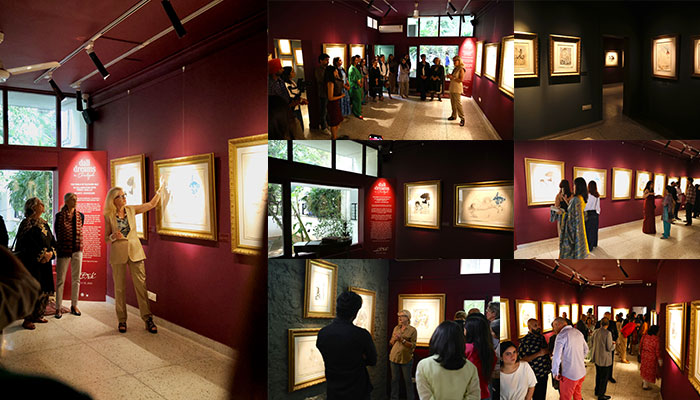
● For the first time, Salvador Dalí comes to Chandigarh – November 14-30 at 105arts Gallery, Chandigarh.
● “Dalí Dreams in Chandigarh is a story about movement—of art, ideas, people and legacy. A collection that began with a friendship in Paris travels to India.” Mehak Bhan, curator-founder 105arts
● “The difference between a mad guy and myself is that I am not mad’! What he was creating was a legacy, and so diverse and universal. He was the Leonardo da Vinci of the 20th century.” Christine Argillet, International curator, gallerist and custodian of the Pierre Argillet Collection
● “Dali and MF Husain remind me of each other – they were amazing personas, great performers and superb marketers – they knew how to sell their art.” Dr Alka Pande, eminent art historian, curator and author
THIS November 14, Mehak Bhan, curator founder 105arts has brought home a rare collection of original Dalí etchings and gouaches from the Pierre Argillet Collection—a privately held collection shaped by an extraordinary three-decade relationship between Salvador Dalí and the Argillet family.
The exhibition will make only two stops in India: Chandigarh and Mumbai, making its arrival at 105arts a significant cultural moment for the region and a rare opportunity for Indian audiences to encounter these works in person. The exhibition is till November 30th at 105arts, Sector 11, Chandigarh.
More than an exhibition, Dalí Dreams in Chandigarh is an invitation into the world behind the legend: Dalí the artist, innovator, provocateur, friend and endlessly curious human being—and the family that knew him personally and preserved this remarkable chapter of his creative legacy.
Day one kickstarted with an engaging panel discussion between eminent art historian, author and curator Dr Alka Pande, international curator, gallerist & custodian of The Pierre Argillet Collection and Mehak.
“Dalí Dreams in Chandigarh is a story about movement—of art, ideas, people and legacy. A collection that began with a friendship in Paris travels to India,” shared Mehak, bringing an extraordinary chapter of the celebrated Surrealist’s artistic legacy to North India.
Salvador Dali (1904-1989) was one of the defining figures of Surrealism and most recognisable artists of the 20th century. “Owning one of his etchings offers a tangible connection to his extraordinary imagination, artistic experimentation and enduring cultural legacy. It’s owning a piece of history,” she added.
The collection brings together a rich variety of works, including etchings, engravings, original watercolors and tapestries. Together, they explore the themes that captivated Dalí ̶ mythology, literature, science, dreams and the surreal ̶ revealing his extraordinary ability to transform ideas into unexpected and thought-provoking creations.
With original Dalí etchings available from approximately ₹10 lakh onwards, the exhibition offers an opportunity to explore the considerations that shape art acquisition — provenance, rarity, authenticity, market demand and long-term collectability — alongside the risks and nuances of treating art as an investment. In fact, an original etching bought by renowned Indian academic, author and museum curator Dr Alka Pande in the 1990s for Rs 3000 is now priced at more than Rs 12 lakh!
But beyond the exhibition itself lies a compelling story: as Indian investors diversify beyond conventional asset classes, can original art become a meaningful part of a wealth and collecting strategy reflecting the changing economics of collecting art in India? “It’s a huge event for us.
The arrival of this internationally significant private collection reflects the growing potential of the Tricity as a destination for art appreciation, patronage and collecting. It offers an opportunity to examine the evolving relationship between regional wealth, cultural aspiration and the market for collectible art.
Among the galleries considered in India, the Pierre Argillet Collection chose 105arts because of its distinctive curatorial vision and its work in developing Chandigarh’s cultural landscape, mentions Christine.
“The choice of Chandigarh is both cultural and strategic. The city has a sophisticated, well-travelled audience with an established appreciation for design, architecture and the arts, alongside a growing community of serious collectors and connoisseurs,” says Christine adding how for Chandigarh is emerging as a cultural gateway to North India provides a new cultural lens through which Dalí’s work can be experienced.
“Dalí was fascinated by the East despite never travelling beyond Greece; he imagined distant places through his own creative lens. Bringing his work to Chandigarh allows audiences to engage with that imagination from a completely different cultural perspective,” says Christine for whom, Chandigarh, with its visionary modernist spirit and Le Corbusier’s architectural legacy, feels like a natural setting for Salvador Dalí’s extraordinary imagination and his ability to challenge conventions. Bringing the Dalí & Argillet collection here is also deeply personal: “it allows me to share the artistic legacy of Salvador Dalí and my father, Pierre Argillet, publisher and close collaborateur, with a new generation of Indian audiences,” she adds.
“My father, Pierre Argillet, who was Dali’s friend, collaborateur, publisher and confidant, had a fascination for Dali. He was capable of drawing anything just by heart, by memory, always craving for something new, straight from a dream and vision. He was immensely skilled and a master craftsman,” Christine, who grew up watching Dali in person, shared about his art, his eccentricities, his spontaneity and he worked intuitively without censoring himself. “He once came across a dead octopus, and saw art in it – immersed it in acid and threw it on his copper etching plate to create wonderful art! He would read extensively and when he had absorbed all that he would unleash, free and fluid, revealing his inner psyche. It was never madness. He used to say ‘the difference between a mad guy and myself is that I am not mad’! What he was creating was a legacy, and so diverse and universal,” added Christine.
Interestingly, he designed the Air India ash tray in the sixties and asked for a baby elephant as payment! “He designed a tapestry and it was done with the master weaver who wove for Le Corbusier,” Christine shared Dali’s connection to India through his inspired works. “The Hippies was his last connection, moved by the movement of spiritual quest of western world in the east. I came to India with my father in 1970…it was very different back then and we came back with a lot of photos and showed them to Dali. He was amazed by them, and so happened the Hippies, a series of 11 etchings he drew in a feverish moment,” Christine goes on, calling him the ‘Leonardo da Vinci of the 20th century’.
Dr Alka Pande, while sharing her love for art and Chandigarh, shared how as a student of art history she didn’t like Dali. “I didn’t understand him. In India you grow up with gods and goddesses, the classical beauty. Dali with his iconic moustache and distorted images was unrelatable, it’s only when you grow up, experience life and understand art that you take a liking to Dali,” she reflected. Art is anything that moves you, she went on to share an invigorating slide show of Dali’s works and what made them a great investment. “He was a filmmaker, sculptor, performer, photographer, writer, printmaker, designer, Dali and MF Husain remind me of each other – they were amazing personas, great performers and superb marketers – they knew how to sell their art. Dali dealt with psycho analysis, dreams, depression, anxiety and transformed surrealism. His was a super realistic work for made invisible visible,” Dr Pande added how India based artist Dushyant Patel is influenced by Dali.
For both Pande and Christine, it’s important to pick the art that talks to you, and then go from there. “Art is a form of mirror, it has to enrich you, move you, relate to you,” said Christine while for Pande, who is not a collector but a lover of art, it’s ‘parmananda’ for her. “But if you’re serious about it, then study it because it’s like stocks and shares.”