
Welcome to Banana Republic of Reputation, How newspaper Frontpages turned into Naam Daan Gospels for Rape Convicted
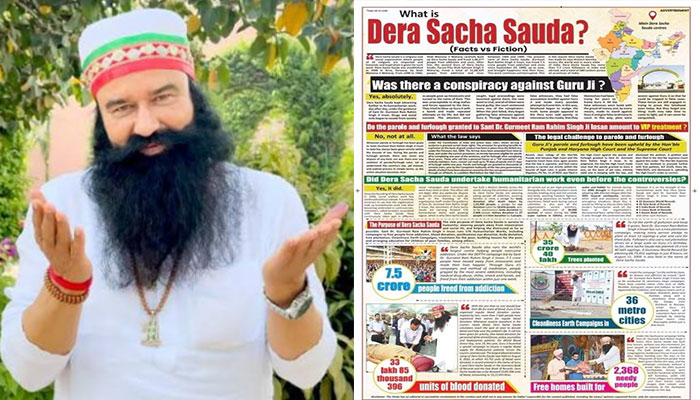
When a Front Page becomes ‘Naam Daan’
There are times when the media writes a satire of itself. No columnist has to exaggerate, the facts are quite capable of doing the job.
A convicted godman finds himself occupying the kind of newspaper space that can give a public image a second life. At that point, one is tempted to ask whether we are still reading journalism—or watching a reputation being carefully put back together in public.
A front page is not just another piece of paper. It carries a certain authority. When a person with a criminal conviction is given that kind of prominence, the issue is not simply what he has been allowed to say. The more serious question is what the newspaper, by giving him that space, is helping the reader see—and what it may be helping the reader forget. That is when the irony becomes difficult to ignore.
A convicted rapist associated with one of India’s most elaborate personality cults receives prominent newspaper space to present himself through the familiar vocabulary of compassion, spirituality, humanitarianism and persecution and not a single word of his criminal past.
And the tragic part is the newspaper that happens to be most trusted voices.
One is almost tempted to check whether the masthead has quietly acquired a new tagline- All the news that’s fit to rehabilitate.
Gurmeet Ram Rahim Singh has every right to speak. He can tell his story, defend himself and present whatever version of himself he chooses.
But The Newspaper has an even more important responsibility that is to question the version rather than simply provide it a larger stage.The issue, therefore, is not free speech. It is editorial judgment.
When a convicted rapist is given prominent space to recast himself through the language of humanitarianism and persecution, the newspaper is no longer merely reporting what he says. It is deciding how prominently his self-portrait should hang in the public gallery.That is where the line between journalism and PR management begins to blur.
The uncomfortable question is simple, is this journalism examining a controversial figure, or is journalism being used to plating the one in gold? A newspaper known for its editorial seriousness should be held to a higher standard, not a lower one.The Dera may have its devotees. A newspaper should have its doubts
From Dera’s darbar to the newspaper’s front page
Dera Sacha Sauda spent decades perfecting the oldest trick in the history of organised power. It used the trick to turn a man into a myth, and eventually people stop asking about the man.
The guru made larger than the institution.
The institution made larger than scrutiny.
The followers directed like sheep herd and eventually a headless Horde of Zombies. Finally, The audience converts into a political constituency. It was not merely religion.It was branding before branding became an MBA subject.
There was spirituality, entertainment, political signalling, social mobilisation and personality worship, all carefully mixed into one spectacular public product.Everything was going great but suddenly came the inconvenient intervention of the law.
The saint acquired a criminal record.
The halo met the courtroom.
Reality interrupted the myths.
But mythology, as history repeatedly teaches us, is remarkably difficult to kill.
It merely changes its costume.Yesterday, the costume was that of a divine messenger. Today, perhaps, it is that of the persecuted humanitarian.
And Tomorrow? Who knows. Maybe Nobel Peace Prize candidate or a torchbearer of the women rights. Everything is possible, it just require a newspaper, some reputation management and mission accomplished.At this rate, the rehabilitation department of the universe is clearly working overtime.
The strange afterlife of a public image
There is something philosophically fascinating about the modern cult leader. He does not merely want followers. He wants memory. He wants to control how history remembers him after the facts have become inconvenient.For that task journalism enters the story.
A newspaper can say, a cult cannot easily say itself. It can lend institutional credibility. The Dera creates devotees. The newspaper creates legitimacy. And that difference is enormous. This is the media’s magic mushroom —that can reshape reality. A cult asks you to believe in the man. Journalism is supposed to ask you to examine the man.When those roles begin to blur, public should become nervous.
Because the danger isn’t that a convicted person is allowed to do play narratives while being in jail. The danger is that his narrative receives the architecture of credibility without an equally visible architecture of scrutiny.
Welcome to the Banana Republic of Reputation
India has perfected many forms of theocracy.There is religious theocracy,where the guru becomes larger than reason.There is political theocracy, where the leader becomes larger than institutions. There is electoral theocracy, where winning an election begins to look like moral absolution.And now perhaps we are developing a fourth-
Reputational theocracy—where enough publicity can make yesterday’s scandal look like today’s persecution. The principle is wonderfully democratic. Everyone is equal. Everyone has the freedom to speak. But not everyone gets the same amount of space, and certainly not the same size photographs.
That matters more than it may seem. A photograph can make a controversial figure look familiar, approachable, even sympathetic. The language around it can do the rest. Slowly, almost imperceptibly, a person moves from being known primarily as a convicted individual to being described as a controversial public figure.
The facts have not changed. The conviction has not disappeared. What has changed is the frame in which the reader is being asked to see him and in journalism, the frame is rarely innocent.
That single adjective, controversial,has probably rescued more reputations than any public-relations agency in history.
It is journalism’s diplomatic passport.
A criminal becomes “controversial.” A convicted person becomes “polarising.” A powerful man becomes “misunderstood.” And, slowly, the uncomfortable facts are reduced to “one side of the story.” This is how language works when it stops merely describing reality and starts managing it.Language is often the first rehabilitation centre.
The Irony of Our Times
The crisis of modern journalism is not simply that newspapers have lost some of the trust they once enjoyed. The deeper crisis is that they now have to work harder to prove that they deserve the trust they enjoyed. A newspaper does not survive merely because of its archives, its history, or the weight of its name. Its greatest asset has always been something far more fragile and far more valuable, the reader’s belief that its judgment cannot be bought cheaply.
And the price of influence is not always paid in money. Sometimes it is paid in access, in proximity to power, in prestige, in invitations, in recognition, or in the temptation of a compelling narrative that feels too important to challenge. The danger begins when a newsroom starts valuing the power of a story over the responsibility behind that story.
But where is the victim in this theatre of reputation?
That is where the satire must pause.
Because beneath the irony lies something deeply uncomfortable, a human tragedy. The convicted man gets a narrative. The institution gets a history. The guru gets a biography. The humanitarian gets a photograph. But The victim, gets only a legal description , a name in a document, a statement in a case file, a forgotten reference in a larger story.
Victims rarely receives the kind of publicity that powerful receives.
This is the uncomfortable challenge before journalism today. When does storytelling become image-making? And when does image-making begin to resemble public relations? The difference between a newsroom and a publicity department is not always visible from the outside. Sometimes the language remains the same. The words are polished, the pictures are powerful, and the narrative is carefully crafted. But the purpose changes.
The Dera’s mistake would be to believe that a leader can become divine through devotion alone. Journalism’s mistake would be to help create the appearance of divinity.
When the Portrait Replaces the Past
Reputation management has a familiar formula, the greater the damage to an image, the more elaborate the story required to repair it. The convicted man becomes a humanitarian. The disgraced politician becomes a statesman. The authoritarian becomes Adored. The controversial businessman becomes an entrepreneur. The scandal-hit celebrity becomes an icon.
The past does not always disappear. It is simply surrounded by a more attractive narrative.
In the modern economy of reputation, perception often competes with reality. A damaged image does not always seek accountability, sometimes it seeks reinvention. A controversy does not always end a public life; sometimes it becomes the beginning of a carefully managed comeback. And perhaps the most fascinating transformation is that even a convicted godman can seek a fresh biography.
Because in the age of reputation, the battle is no longer only about what happened. It is also about how to tell the story later. Apparently, even he can get a fresh biography, an updated Wikipedia.
Journalism’s Last Line of Defence
One could almost prepare a new dictionary for the age of reputation management.
Where Conviction becomes controversy, when a cult becomes a spiritual movement. Political influence becomes social service. Publicity becomes humanitarian work. And, perhaps most dangerously, reputation management begins to disguise itself as journalism.
Because journalism’s purpose was never to provide comfortable explanations for uncomfortable questions. It was never meant to be a rehabilitation centre for damaged reputations or a factory for manufacturing new identities.
Journalism is not in the business of deciding who deserves redemption. That responsibility belongs to courts, conscience, society, and ultimately, history. The journalist’s responsibility is both simpler and far more difficult , to ask the questions that power would rather avoid.
A newspaper should not exist to repair reputations. It should exist to examine them. It should not manufacture godmans, it should carry a magnifying glass whose stable focus can burn anything, anytime. The questions are not complicated. What does the evidence say? Who was harmed? What remains unresolved? What context is missing? And why is this particular narrative being presented to readers at this particular moment?
Those questions are not acts of cruelty.
They are the foundation of journalism.
The Irony of Manufactured Memory
Dera Sacha Sauda spent years building an extraordinary mythology around its leader. Journalism, at its best, was built on the opposite principle , that nobody is above scrutiny.
Not the politician. Not the billionaire. Not the religious leader. Not the government. And certainly not the newspaper itself.
The Dera can afford to believe in its own mythology but newspaper cannot.
Because once the image of a convicted man becomes more powerful than the questions surrounding his conviction, the issue is no longer only about one individual or one photograph. It becomes a larger question about who controls public memory.
A court records what happened. A cult records what it wants people to believe happened. Journalism, at its best, exists in the uneasy space between these two realities — not as a believer, not as a prosecutor, but as a witness committed to asking uncomfortable questions. Because if journalism abandons that role, history may not be written by the winners after all; it may be written by those who controlled the image, secured the most sympathetic profile, and crafted the most persuasive narrative. And perhaps that is the most uncomfortable irony of our time: Dera Sacha Sauda spent decades building a godman, but if journalism participates in rebuilding that carefully constructed image, the guru has not conquered the newsroom — the newsroom has simply surrendered its own language and begun speaking his.
GURPREET MIRPUR
POLITICAL EDITOR
DAILYPOST TV
7042643327